
Beyond the guesswork.
What is a nanobubble?
A nanobubble is an extremely small gas bubble suspended in water. Also known as an Ultra-Fine Bubble (UFB) according to ISO 20480-1, it is essentially the same type of gas bubble found in everyday life — but reduced to a size where its behaviour changes completely.
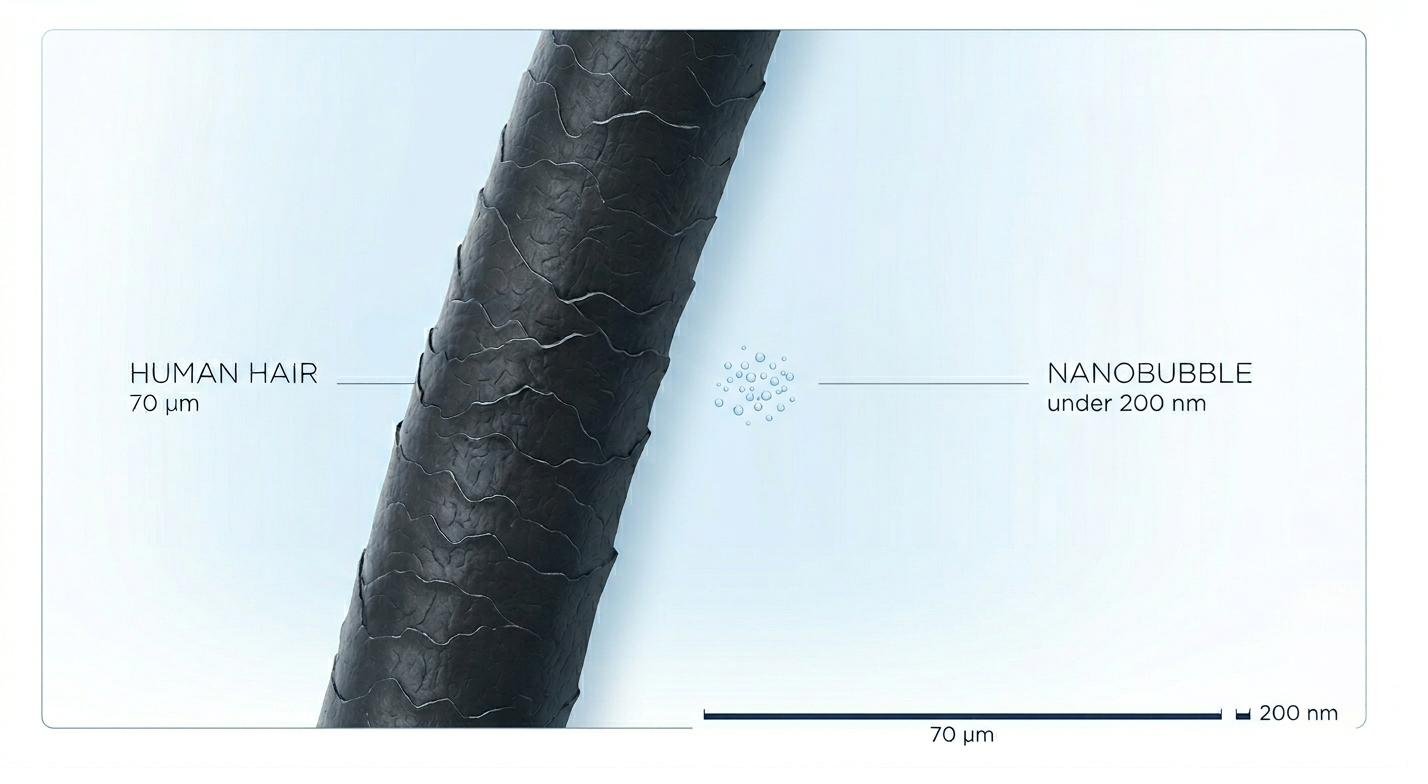
A typical visible bubble is around 1 millimetre in diameter, while nanobubbles are usually smaller than 200 nanometres — approximately 10,000 times smaller than ordinary bubbles. At this scale, they are invisible to the naked eye, and water containing billions of nanobubbles can still appear completely clear.
Scientists discovered that when bubbles become this small, they develop unique physical properties that are not observed in conventional bubbles.
In the following sections, we explore the three key properties that make nanobubbles valuable across many applications.
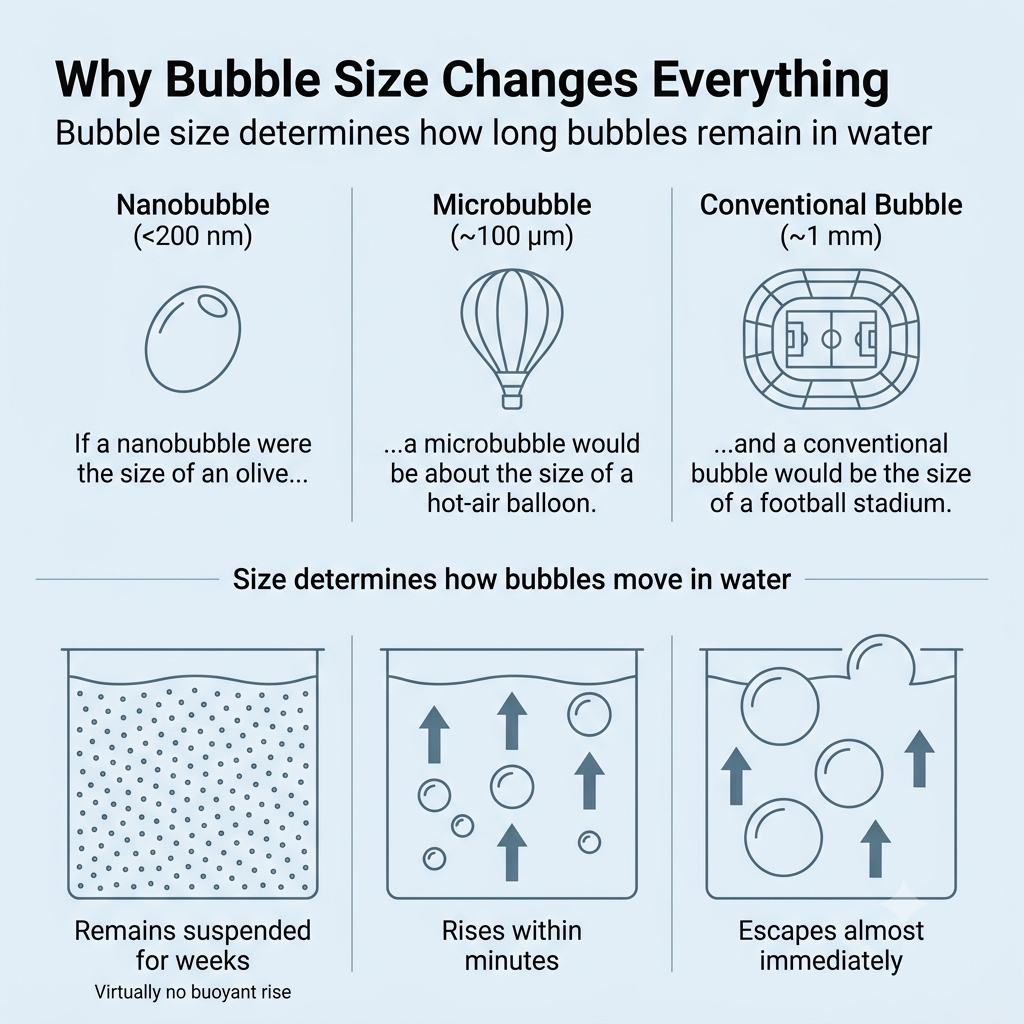
Too small to rise
A nanobubble at 200 nanometers is invisible to the naked eye and has a buoyancy force so negligible that Brownian motion dominates entirely — it wanders, but never climbs.
Its surface carries a strong negative zeta potential (typically −20 to −40 mV), creating electrostatic repulsion that prevents coalescence. The result: a gas phase that remains dissolved in the liquid for hours to weeks.
The practical consequence is profound. Gas — oxygen, ozone, CO₂, nitrogen — can now be delivered deep into a liquid and kept there long enough to actually interact with biology, chemistry, or surfaces.
Reduces surface tension
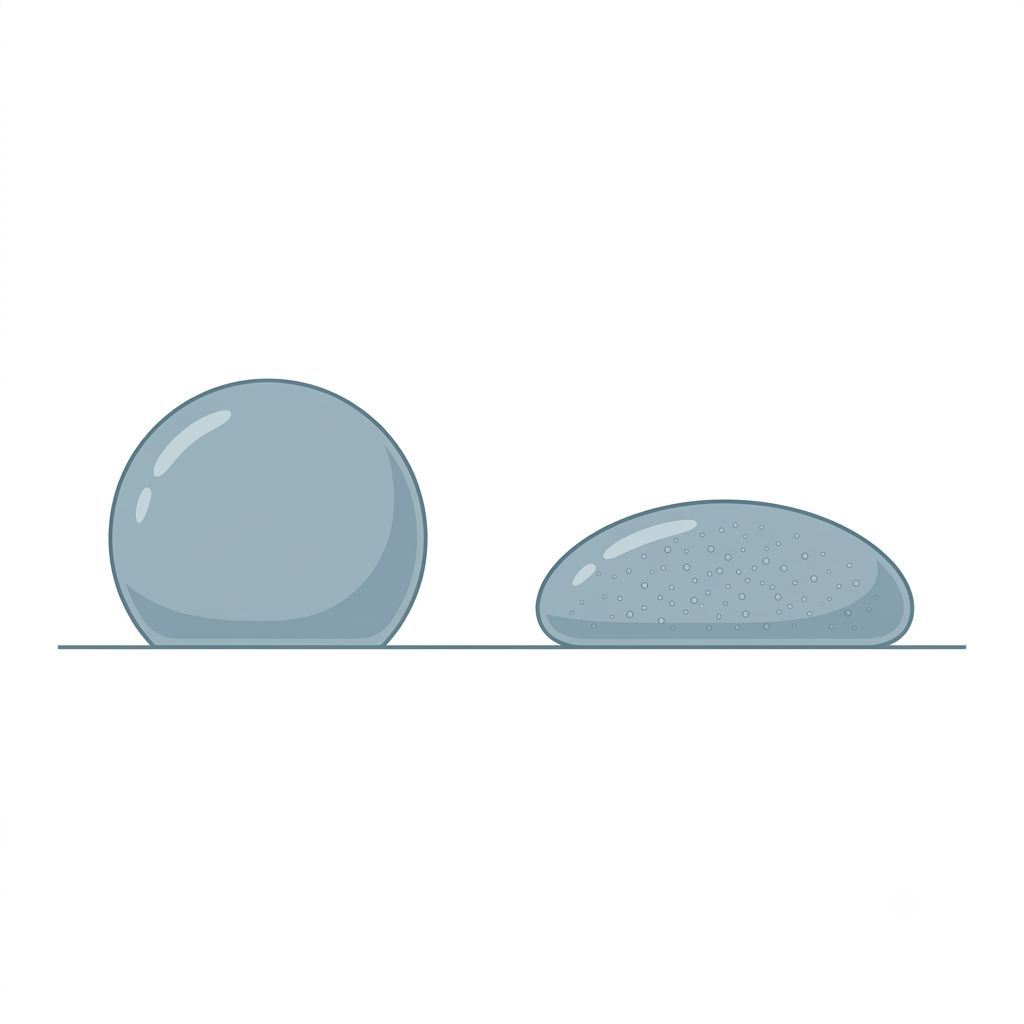
When nanobubbles accumulate at a solid–liquid interface, they disrupt the cohesive hydrogen-bond network that gives water its surface tension. This makes water “wetter” — it spreads further, penetrates deeper, and detaches soils and contaminants more efficiently.
In washing applications, this means the surfactant threshold — the minimum detergent concentration needed to achieve the same soil removal — drops substantially. Laboratory studies on textile washing consistently show equivalent or superior cleaning performance at significantly reduced chemical load.
Surface charge
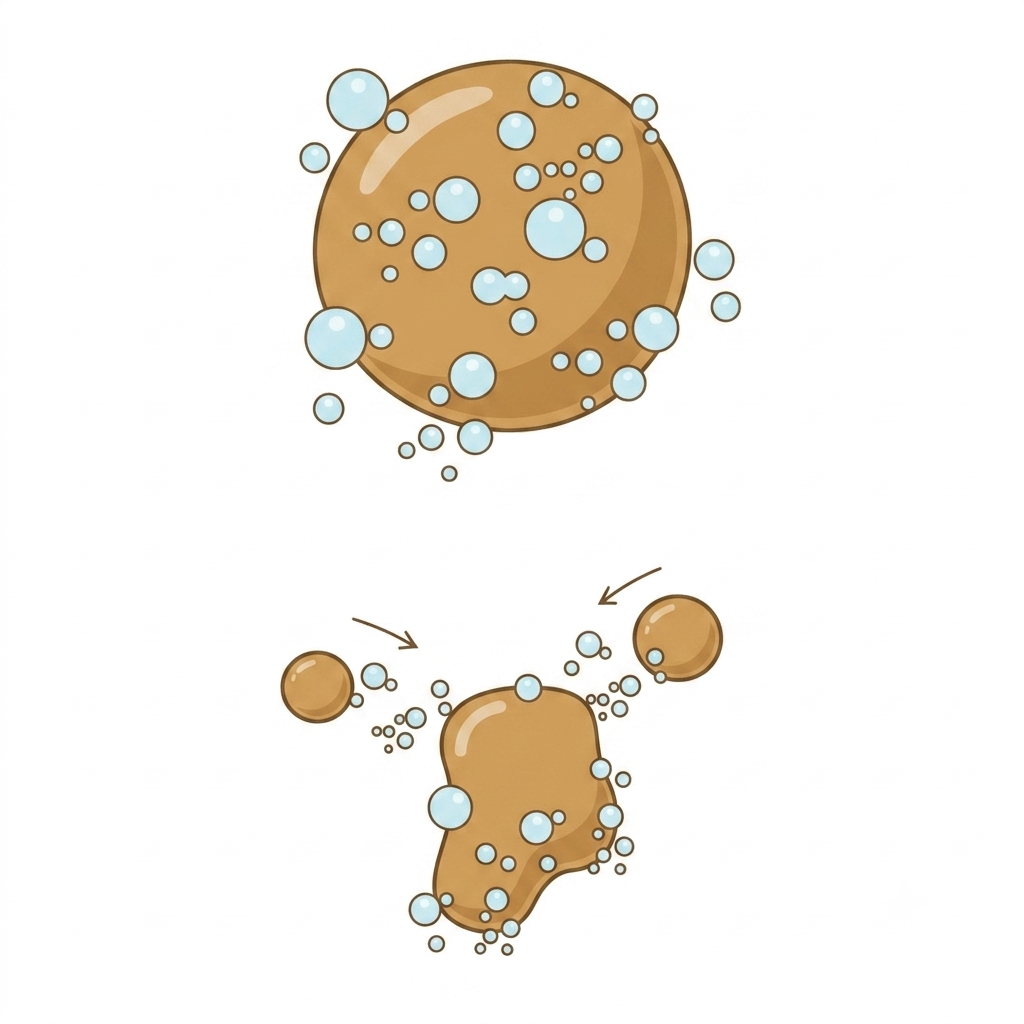
Ultra-fine bubbles (UFBs) carry an electrical charge on their surface. This property helps them interact with particles suspended in water, making them useful for separation processes.
In wastewater treatment, the negatively charged oil droplets attract the positively charged bubbles. The bubbles attach to the oil and start working as a float, helping the oil rise to the surface, where it can be removed by flotation.
The charge forms because water contains both H⁺ and OH⁻ ions. And they are attracted by the bubble surface. As a result, in acidic water, H⁺ is more abundant and coats the bubble’s surface, giving it a positive charge. In alkaline water, OH⁻ dominates instead, giving the surface a negative charge.
UFBs can also improve the removal of fine suspended particles. They can interact with coagulant chemicals, attracting suspended materials, helping small particles clump together into larger, heavier flocs that settle more easily.
It’s worth mentioning that bubbles in the same body of water carry the same charge as each other. This causes them to repel one another, helping the gas stay in the liquid for longer.
Where nanobubbles are used
The properties described above are not application-specific. The same physics appears in a shrimp pond, a membrane filter, and a washing machine drum. What changes is which property does the work.
Each application below links to a technical article, a free reference PDF, and where available, a full guide.
START HERE — FREE PDF
5 Nanobubble Myths Debunked
Nanobubbles do a lot, but not everything they are sold for. Before committing to any of the applications above, it is worth knowing which effects hold up in published research and which ones exist mainly to move equipment. This short PDF covers the five claims that come up most often, and what the evidence actually says about each.